
Water supply failures in rural communities rarely happen without warning. The warning signs are there in the data – pressure drops, abnormal flow rates, pump energy deviations – but without continuous monitoring, those signals go unnoticed until the system fails entirely. The Leskovets Village project, delivered in partnership with Berkovitsa Municipality, demonstrates how IoT-based monitoring transforms water infrastructure management from reactive to preventive.
The Problem with Reactive Maintenance
Leskovets had long suffered from unreliable water supply – insufficient flow, low pressure, and seasonal shortages. Pump operations were manual, requiring technicians to visit the site to start or stop equipment. Problems were discovered only after they caused disruption: a pump running dry, a pressure collapse, a distribution failure. This reactive approach is common across small municipal water systems. Without data, there is no early warning – only emergency response.
IoT Monitoring as the Foundation of Preventive Maintenance
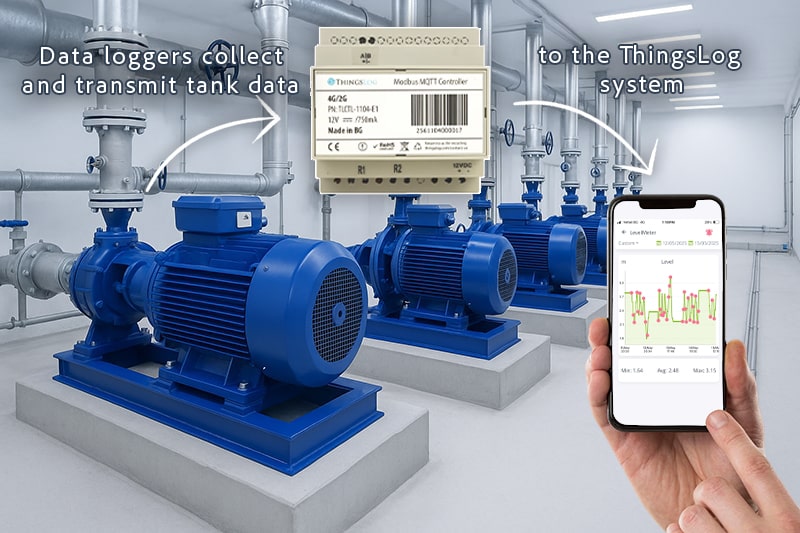
UtilTex, using the ThingsLog IoT platform, deployed a continuous monitoring and automation system across the village water infrastructure. Every operational parameter – pump status, flow rate, pressure, energy draw – is tracked in real time and fed into a centralized management platform accessible remotely by operators. This continuous data stream is what makes preventive maintenance possible:
- Dry-run detection: abnormal pump energy consumption signals that water is not flowing – a leading indicator of pump damage if not addressed promptly
- Pressure anomalies: unexpected drops indicate pipe leaks or valve failures before they become visible
- Flow deviations: changes in expected flow patterns highlight blockages or infrastructure degradation early
- Pump cycle irregularities: unusual start/stop frequency indicates control or mechanical issues requiring inspection
From Scheduled Visits to Condition-Based Intervention
With continuous IoT monitoring, maintenance is now triggered by actual equipment condition. Operators receive alerts the moment a parameter deviates from baseline, enabling them to dispatch a technician precisely when and where intervention is needed – before a failure occurs. The project was funded through the national “Kapka po Kapka” grant programme with a total budget of BGN 30,200, demonstrating that IoT-enabled preventive maintenance is accessible even for small municipalities.
Results
- Continuous, reliable water supply – interruptions eliminated
- Manual pump operations replaced by automated, condition-monitored control
- Maintenance team responds to data-driven alerts rather than resident complaints
- Critical failures prevented through early anomaly detection
- Full remote visibility into infrastructure health, 24/7
This case study is powered by UtilTex using ThingsLog IoT monitoring technology.